
Saria


Gender Pay Reporting – 2025/2026
SARIA Ltd operations in the UK are active in a wide range of sectors associated with the food chain. The Group’s companies manufacture quality products for use in human and animal foodstuffs, agriculture, aquaculture, and industrial applications. The company also produces biofuels and renewable energy and provides services for farming and the food industry.
Gender Pay Gap reporting measures the difference in average hourly pay and bonus pay between men and women across an organisation. It is important to note that a gender pay gap does not necessarily indicate unequal pay for equal work. Instead, it reflects differences in the distribution of male and female employees across different roles and levels within the organisation.
SARIA Ltd operates across multiple business units with different payroll structures. For the purposes of this report, we focus on employees who were classified as full time / full pay relevant employees during the payroll period, including 5th April 2025. This is the snapshot date for the April 2025/2026 data.
Below is a graph showing our ‘gender pay gap’ across the UK, compared with that within the UK, according to data from the Office for National Statistics.
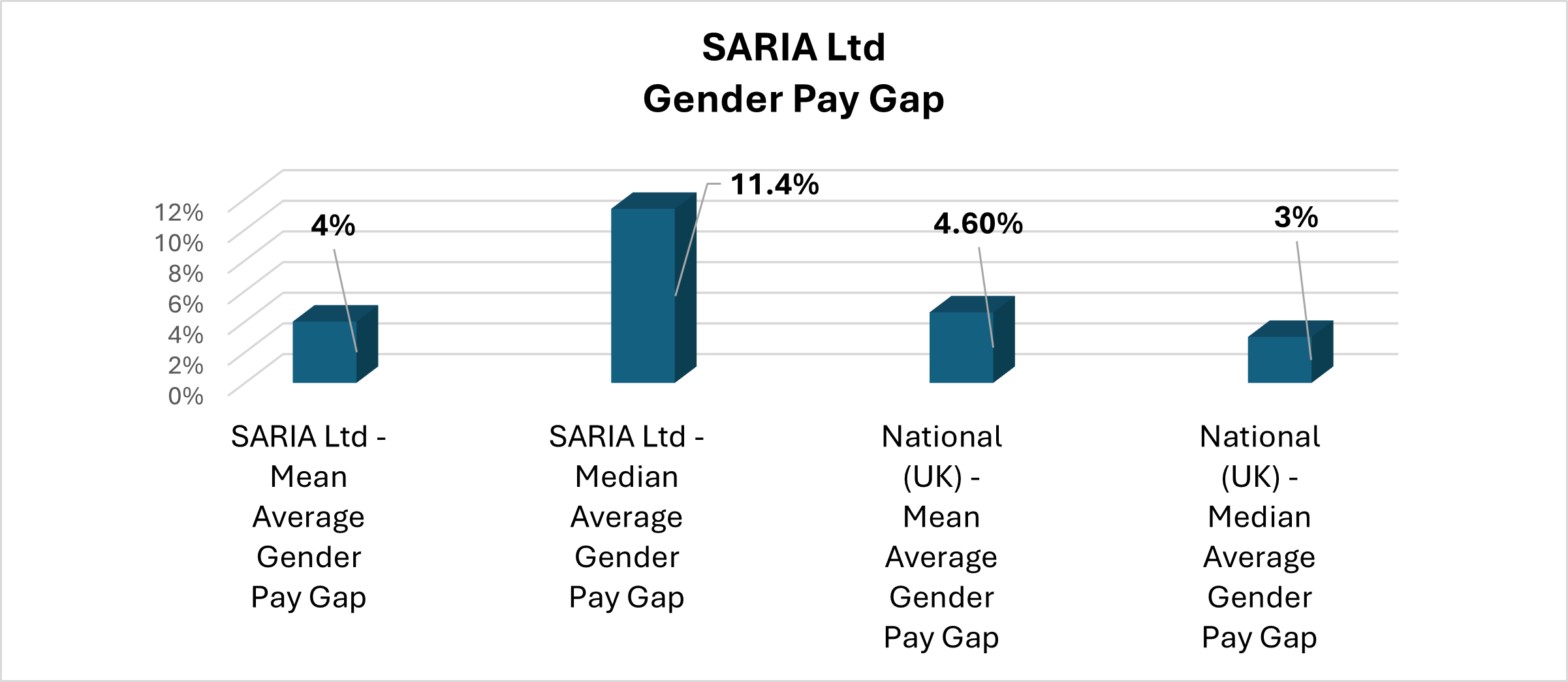
These figures show the difference between the average hourly pay levels of all women compared to all men, irrespective of their role or grade in the organisation, expressed as a percentage of men’s average pay (as per the required gender pay gap reporting requirements).
For the 2025/26 reporting period, our results show a continued narrowing of hourly pay gaps, indicating positive movement. When considering the mean hourly pay gap is 4%, and the median hourly pay gap is 11.4% in comparison to last year the improvement is evident. As the mean hourly gender pay gap was 14.3% and the median hourly gender pay gap was 16.4% in 2024/25, demonstrating progress as representation and workforce composition evolves.
The existing gap is predominantly due to a male-orientated workforce, making up over 86% of eligible employees. This percentage is high due to the nature of our business and our working patterns, staffing a 24 hour / 7 day a week operation, working 12-hour shifts of days and nights. Our Gender Pay Gap is further influenced by semi-skilled, qualified / skilled employees, including HGV Drivers, Operatives, Electricians, Mechanics and various maintenance roles, which are historically filled by a greater number of male employees in comparison to females.
As a result, the gender pay gap is influenced primarily by the under-representation of women in operational, transport, engineering / technical and senior operational roles rather than unequal pay practices.
There are also an increasing number of our female employees who choose to participate in family-friendly offerings, including childcare schemes and part-time/flexible working, which reduces the hourly rate accordingly.
However, improvements have been made on previous years’ figures due to encouraging promotion and recruitment of women into technical / maintenance, management and senior positions within the Company. In addition to this, there has also been a re-structuring of employees in senior leadership positions that has resulted in a reduction of board members. Therefore, reducing the overall disparity between hourly rates, amongst all employees. The changes to the board have also resulted in a closure of the hourly rate (gender pay gap) between males and females within the Company due to a reduction in headcount of males in such senior positions.
The graphs below illustrate SARIA Ltd’s gender distribution across hourly paid quartiles, each containing 147 employees:
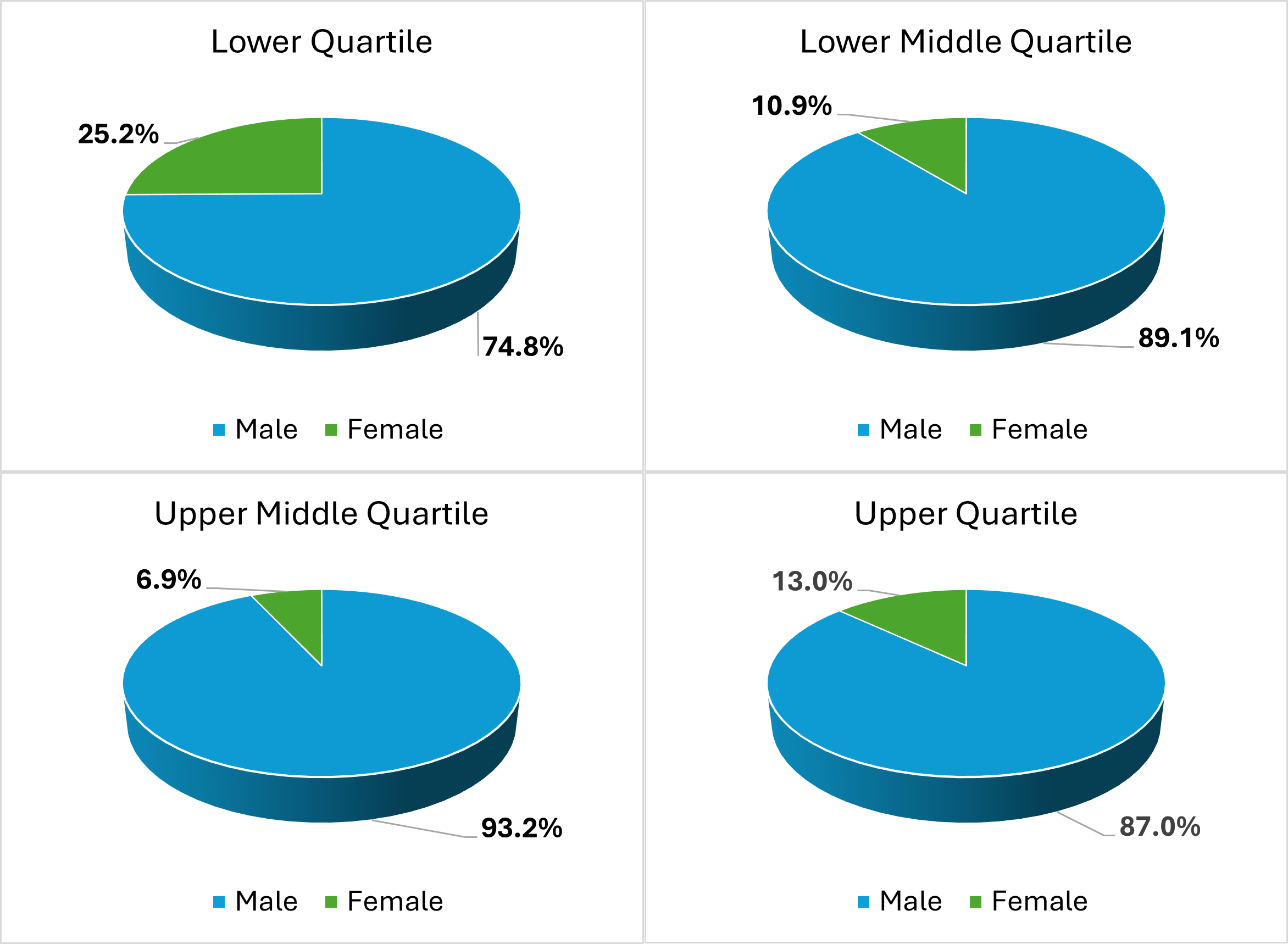
A review of pay quartiles and workforce composition in 2025/26 shows that women represented 14% of our overall relevant employee population. Analysis of pay quartiles shows that female representation increases in the lower and upper quartiles. Female representation in the upper quartile has increased from 8.9% in 2024/2025 to 13% in 2025/2026, demonstrating some movement into higher-paid roles. Regarding the lower middle and upper middle quartiles, the female representation is lower due to the vast number of roles in these quartiles that are of an operationally skilled / technical and / or of an engineering composition, whereby females are currently un-represented within the Company and externally.
These structural factors continue to be the primary driver of our Gender Pay Gap, rather than unequal pay practices. We regularly review our pay practices to ensure compliance with equal pay legislation and are confident that men and women are paid equally for doing the same or equivalent work.
Bonus payments do not form part of SARIA Ltd’s normal remuneration package and during the snapshot period for 2025/2026, no discretionary bonuses were paid.
Commitment to Progress and Future Actions
We recognise that closing the Gender Pay Gap requires sustained, long-term action, particularly within a male-dominated industry.
Currently SARIA Ltd operates its pay analysis through a salary and grading structure, managed by Job Evaluation, which considers the following factors:
- Education & Level of Skill
- Proven Ability
- Managerial Responsibility
- Accountability
- Independence of Action
- Complexity
- Relationships – Internal & External
- Direction (Supervision Received)
- Pressure of Work & Working Environment
The job evaluation process objectively assesses roles rather than their post-holders, thereby removing any reference to gender. Roles are evaluated based on detailed job descriptions, and the requirements of the role as per the expectations of the role’s line manager.
While we are encouraged by the progress reflected in this year’s results, we remain focused on improving representation, progression, and opportunity across the organisation. We recognise that meaningful change in gender representation within the manufacturing sector takes time. Our focus is therefore on creating sustainable improvements in attraction, development and progression to support a more balanced workforce over the long term.
Our ongoing priorities include:
- Supporting career development and progression pathways.
- Promoting inclusive recruitment and talent attraction practices.
- Continuing to review reward and pay structures for fairness and consistency.
- Openness to flexible working practices to support retention and inclusion.
We remain committed to building a fair, inclusive workplace where all employees can develop and succeed. This statement confirms that the gender pay gap information published in this report is accurate and has been calculated in accordance with the methodology set out in the Equality Act 2010 (Gender Pay Gap Information) Regulations 2017.
Signed:

Thomas Versterre
CEO
SARIA Ltd